
Bellone
An ancient Lazio white, known around Capena as “uva di Spagna”.
Bellone is a grape variety most associated in Italy with Bianco Capena, Cerveteri, Circeo and Colli Lanuvini.
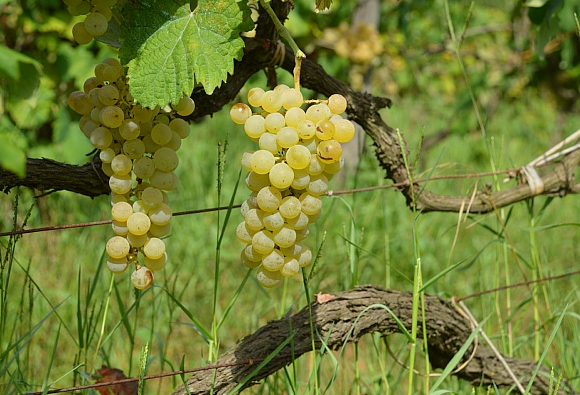
Bellone is one of the most undervalued white grapes in Italy, a Lazio native capable of dry wines of unusual texture and sweet wines that stand comparison with the best in the country. Most of the growers who still have it treat it as a minor component in a blend, largely because few of them own enough of it to do anything else. Where someone has gathered enough to make a varietal wine, the results are startling.
Origins and history Bellone’s ancestor is thought to be the Uva Pantastica that Pliny singled out in the Naturalis Historia as a grape of particular quality. Ancient Rome knew a family of grapes called the Belli, named for the opulent look of their bunches, and Bellone sits among them in the nineteenth-century descriptions of Di Rovasenda and Mengarini. The name Uva Pane, from the belief that the grape was as good as bread, is probably another synonym, though a minority still argue it is a separate variety.
A grape of many names Its vigour earned it the nickname Pagadebito, “debt-payer”, a name Italy has handed to any number of generous croppers and not to be confused with Emilia-Romagna’s Pagadebit. It is also called Cacchione, Pampanaro and, less accurately, Arciprete. Bellone matches only one Arciprete biotype, the smooth-leaved Arciprete Bianco Liscio; the hairy-leaved Peloso is a rarer and distinct thing. Best of all its names is Pacioccone, which translates roughly as fatso and describes the large round berries and portly bunches exactly.
In the vineyard Both biotypes show very low basal bud fertility, which rules out spur cordon training altogether and forces growers to use longer canes. The berries are large and notably thin-skinned but rich in pectin and polyphenols. Bellone carries high natural acidity, with total acidity of 8.5 grams per litre nothing out of the ordinary, and that acidity is the foundation of everything good the grape does.
Appearance and structure The dry wines show a luscious, almost resiny texture alongside juicy acidity, and the absence of that creaminess is a reliable sign of careless winemaking. It is a white of real weight that never turns heavy, because the acid line holds it together. Colour runs from pale straw to deeper gold in the late-harvested versions.
Aromatic profile Honey, citrus and tropical fruit dominate, with yellow peach and green apple in the steel-fermented wines and hazelnut and deeper honeyed notes where gentle oak is used. The sweet wines add sweet spice and a concentrated peach character. The overall impression is generous rather than aromatic in the Muscat sense, more about texture and depth than perfume.
In the cellar Those thin skins and the grape’s tendency to oxidise despite its polyphenol content mean the grapes must be pressed slowly and handled reductively. Get that right and the wine keeps its freshness; get it wrong and it tires quickly. The high acidity also makes Bellone a sound base for sparkling wine, an avenue only lightly explored so far.
Key expressions
- Dry varietal whites from Cori, the one area making wines that are 100 per cent Bellone.
- Late-harvested sweet wines, air-dried on the vine into November.
- Steel-fermented styles built on yellow peach and green apple.
- Blended roles in Frascati, Marino and Nettuno, where up to 10 per cent is typical.
The question of aging The dry wines reward three to six years, trading primary citrus for honey and a waxy depth while the acidity keeps them taut. The sweet wines are another matter entirely: made by twisting the stalk in September and leaving the fruit to lose around half its water by November, they are thick, unctuous and remarkably long-lived, kept from cloying by that same high acid. At their best they belong in any conversation about Italy’s greatest sweet wines.
At the table The dry wines take on the richer Roman dishes without difficulty, from carbonara and cacio e pepe to fried artichokes and salt cod, where the acidity cuts and the texture keeps pace. The sweet versions suit blue cheese, almond pastries and ripe stone fruit far better than heavy chocolate. Serve the dry wines around ten degrees and the sweet ones a little cooler.
Why it matters Bellone is proof that Lazio has more to offer than the industrial Frascati that shaped its reputation. It survived precisely where growers were too poor to replace it with something more productive, and the small number of estates around Cori now working with it have turned that accident of neglect into one of central Italy’s most distinctive whites. Few Italian grapes offer so much at so little cost.