
Biancame
The Marche white behind Bianchello del Metauro — pale-berried, saline, and underrated.
Biancame is a grape variety most associated in Italy with Bianchello del Metauro, Colli Perugini, Colli Pesaresi and Esino.
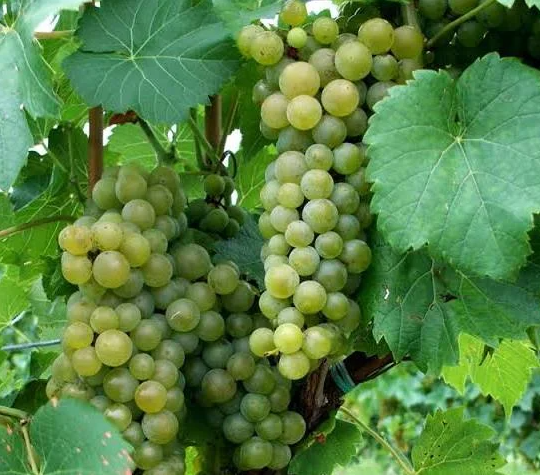
Biancame is the white grape of the Marche coast around Urbino and Pesaro, and the variety behind Bianchello del Metauro. Books, websites, growers, winemakers and even academics routinely call it a synonym of Trebbiano Toscano, and the honest position is that nobody has actually demonstrated this. The two remain separately listed, and they do not look or behave the same.
The identity question A careful review of the parentage and identity literature of the past decade finds the Biancame and Trebbiano Toscano question simply unanswered: there are no recent SSR microsatellite studies, nor even accurate ampelographic verification, confirming the equation. The National Registry keeps them separate, though it muddles matters by listing each among the other’s synonyms while assigning them entirely different certified clones. D’Agata treats them as distinct, on the grounds that in the vineyard they plainly are.
Origins and names Biancame is also called Bianchello, which is the name of its best-known wine, and Balsamina Bianca. The synonym Biancone is wrong: that is very likely a separate variety typical of Elba, itself long confused with Trebbiano Toscano, which is how the mistaken link arose in the first place. An old belief that Biancame was a relative of Greco is also incorrect. There is some evidence that Biancame and Morbidella may be the same, but that needs more work.
A footnote in military history The grape has a claim, of the sort that should be enjoyed rather than trusted, on the outcome of the Punic Wars. The Carthaginian troops of Hasdrubal, Hannibal’s considerably less able cousin, are said to have over-indulged while campaigning in the Metauro and to have been destroyed by the Romans at the battle of Metauro the following day. Historians agree that had Rome lost that battle Carthage would probably have won the war.
In the vineyard Biancame carries medium-large pentagonal leaves with a lightly downy underside, where Trebbiano Toscano’s is far hairier, and large cylindrical-conical bunches often with a forked tip. The berries are medium and yellow-green with very little bloom. That last point is the telling one: even at full ripeness they never turn golden-yellow or reddish as Trebbiano Toscano’s and other Trebbianos’ do, which is exactly what the name, from bianco, records.
Growing it The variety is vigorous and unusually resistant to disease, more so than the other Trebbianos, with only botrytis causing trouble in wet years. Rootstock choice follows the soil: K5BB and 41B on fresher ground, 140 where it is dry. Six official clones exist, four in the CSV-AP PS series plus CAB 19 and CAB 20, which is a good deal of selection work for a grape most people have never heard of.
Appearance and structure A good monovarietal Biancame is light-bodied and lemony fresh, with no pretension to weight or richness. The acidity is its structure, and the wine lives or dies on how cleanly it is made. This is a straightforward white in the best sense, not a simple one by accident.
Aromatic profile White fruit and citrus lead, with delicate herbal nuances underneath and a clean, saline finish that reflects the proximity of the Adriatic. There is nothing showy about it. Where growers push yields the character thins out quickly, which is the usual reason for the grape’s modest reputation.
In the cellar Stainless steel and early bottling suit it, preserving the citrus lift that is the point of the wine. Three DOCs matter: Bianchello del Metauro, the benchmark, plus Colli di Rimini Biancame and Colli di Rimini Bianco, though in the last of these Trebbiano Romagnolo predominates. A handful of producers have begun experimenting with lees ageing to add texture.
Key expressions
- Bianchello del Metauro DOC, the variety’s benchmark wine.
- Colli di Rimini Biancame from the Emilia-Romagna side of the range.
- Lees-aged bottlings from growers seeking more texture.
- Hillside parcels around Urbino, where yields drop and character rises.
The question of aging Biancame is made for the year after the vintage and does not repay patience. Its citrus and herbal lift are at their best young and flatten out within two or three years, taking on a faintly waxy note that adds nothing. The small number of lees-aged wines hold longer, but the grape’s argument is freshness, not development.
At the table This is Adriatic seafood wine and behaves exactly as one would hope, with brodetto, fried anchovies, clams and simple grilled fish. The salinity makes it a natural with shellfish, and the light body keeps it out of the way of delicate dishes. Serve it cold, around eight to ten degrees.
Why it matters Biancame is a useful corrective to the habit of filing every unfamiliar central Italian white under Trebbiano Toscano and moving on. The identity has never actually been demonstrated, the vines look different, and the wine has a clarity of its own. Whether or not the DNA eventually collapses the two, Bianchello del Metauro is worth drinking on its own terms.