
Corinto Nero
A seedless black grape of the Aeolian islands, vinified rather than eaten.
Corinto Nero is a grape variety most associated in Italy with Salina.
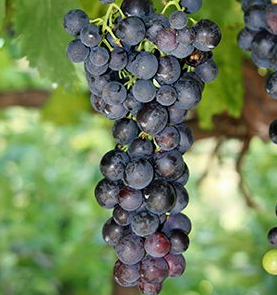
Corinto Nero is a seedless black grape of the Aeolian Islands, almost never made into wine on its own, and quite possibly a virus-ravaged relative of Sangiovese. It is one of the stranger entries in the Sicilian catalogue: a vine so weakened by a century of infection that its own appearance no longer reliably indicates what it is.
Origins and history An ancient variety brought to Sicily by the Greeks, it shares a name with a grape abundant in Greece and Turkey from which it differs. Cupani described three Corinto varieties in 1696, known locally as Tuccarino, Tuccarineddu and Tuccarino cù Cocci. It is unrelated to Corinto Bianco and Corinto Rosa, two other Sicilian natives now virtually extinct.
The Sangiovese question Corinto Nero appears to be a distant relative of Sangiovese, and some experts go further, treating it as a seedless mutation or biotype of the Tuscan variety whose phenotype has diverged because it has been so heavily virus-affected over the centuries. D’Agata finds the connection interesting for a specific reason: the Puglian variety Tuccanese, whose name closely echoes Cupani’s Tuccarino group, has been shown genetically identical to Sangiovese.
Not Termarina Emilia-Romagna’s Termarina Rossa is remarkably similar to Corinto Nero ampelographically, and the two are nonetheless genetically distinct, as shown in 2005. Both are seedless, which accounts for much of the resemblance. It is a useful reminder that in a vine as compromised as this one, appearance proves very little.
In the vineyard Corinto Nero is poorly vigorous, as virus-affected vines generally are, carrying a small, short, cylindrical, winged bunch with very small round purple berries. The seedlessness is its defining trait and the source of its small berries. In Italy it grows only in the province of Messina, which in practice means the Aeolian Islands.
Appearance and structure Because it is so rarely vinified alone, the variety’s character is known mainly through its contribution to blends, where the small, thick-skinned berries give colour and a firm, slightly rustic grip out of proportion to the volume used. The low vigour keeps yields naturally small, which concentrates what there is.
Aromatic profile Dark berry fruit with an earthy, faintly wild edge is the usual signature, without the perfume of Sicily’s better-known reds. It contributes structure rather than aroma, which is exactly why it has always been a blending grape rather than a soloist.
In the cellar Very rarely made as a pure red, Corinto Nero forms part of the Lipari Rosso DOC and accounts for 5 per cent or less of the Malvasia delle Lipari DOC, where the small addition of dark fruit works against the Malvasia’s sweetness. Its role is deliberately minor and has been for as long as anyone has recorded it.
Key expressions
- Lipari Rosso DOC, where it plays its main part.
- Malvasia delle Lipari DOC, at 5 per cent or less of the blend.
- Very rare pure bottlings from Aeolian growers.
- Old island plantings on volcanic terraces around Messina.
The question of aging As a blending component its longevity belongs to the wine rather than the grape, and the Lipari reds are generally drunk within a few years. The rare pure versions carry enough colour and grip to hold four or five, though the variety’s low vigour and virus load make consistency difficult. Nobody keeps it for long.
At the table The Lipari reds it goes into suit the island cooking of the Aeolians: grilled fish, capers, salted ricotta and rabbit. The grape’s grip helps with anything cooked over fire. Serve it at around sixteen degrees, slightly cool.
Why it matters Corinto Nero is a small piece of evidence for how far virus can change a vine’s appearance without changing what it is, and a possible Sangiovese connection in the most unlikely place. It survives on a handful of volcanic islands, contributing a few per cent to wines named after another grape. That is a precarious position, and it has held it for centuries.