
Francavidda
The rounder half of the Ostuni Bianco blend, and another Brindisi exclusive.
Francavidda is a grape variety most associated in Italy with Ostuni.
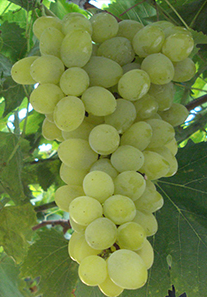
Francavidda is down to about ten hectares. It is named for Francavilla Fontana, the small town near Brindisi where it has always grown, and its range has barely shifted in centuries, which in a variety this scarce is less a sign of stability than of a grape that never had anywhere else to go.
Origins and name Also written Francavilla, the variety takes its name directly from the town, one of the more straightforward naming histories in the Puglian catalogue. Its documented record is thin, as it is for most of the minor whites of the Valle d’Itria and the Brindisi countryside, and it has never been grown outside that small area in any quantity.
In the vineyard The cluster is medium-large, pyramidal-cylindrical, rarely compound and at times very sparse; the berry is mid-sized and round with a thick green-white skin. It is usually harvested in mid to late September. The thick skin and often loose bunch are advantages in a humid southern climate, but they have not been enough to keep the variety in the ground.
Why it declined Francavidda has fallen out of favour for reasons that have nothing to do with the wine. It is too sensitive to spring frost and to cold weather generally, and too susceptible to disease, in particular grey rot. In a region where growers have hardier and more productive whites to hand, those are decisive faults, and the result is the ten hectares that remain.
Clonal work Research begun in the 1970s and continued into the 1990s produced two clones, CRSA-C134 and CRSA-C135, both taken from very old vineyards at Francavilla Fontana and Ostuni. The two have slightly different phenotypes, which is unsurprising given the age and isolation of the source material. That anyone bothered with clonal selection for a variety this small is itself notable.
Where it grows Plantings sit around Brindisi, near Francavilla, Carovigno, Ostuni, San Michele Salentino and San Vito dei Normanni, the same towns that hold Impigno. The two varieties have been companions for as long as either has been recorded, and the geography of one is essentially the geography of the other.
Appearance and structure The wines are very light and fresh, made for uncomplicated drinking, with no weight and no ambition to any. That is a fair description rather than a criticism: in the Puglian summer a white of this kind has an obvious job, and Francavidda does it well enough to have survived alongside more convenient grapes.
Aromatic profile Citrus and green apple with a faint floral lift make up most of what is there, carried by acidity rather than aroma. The thick skins contribute a light textural grip that keeps the wine from being merely thin. Nothing about it is emphatic.
In the cellar Francavidda is usually blended with Impigno in the Ostuni DOC, where the pairing is traditional and the proportions vary; a well-regarded example runs 75 per cent Impigno to 25 per cent Francavidda. Cool fermentation and early bottling are all the grape requires. Varietal bottlings are close to nonexistent.
Key expressions
- Ostuni DOC bianco, blended with Impigno, its traditional partner.
- Wines from the old vineyards at Francavilla Fontana and Ostuni.
- Bottlings using the CRSA-C134 and C135 clones.
- Old mixed plantings around Carovigno and San Vito dei Normanni.
The question of aging D’Agata puts it directly: these wines do not age particularly well. Francavidda belongs to the year after the vintage, and its freshness is the entire proposition. There is nothing in the wine that develops, and a second summer does it no favours.
At the table It is perfect with light vegetable and fish dishes, which is very nearly a definition of what the Brindisi countryside eats: raw seafood, grilled fish, vegetables in olive oil, fresh cheeses. Its lightness is the point. Serve it cold, around eight degrees.
Why it matters Ten hectares is the margin between a variety existing and not existing, and Francavidda sits right on it. It makes a modest wine, it has a real fault in its frost and disease sensitivity, and it has been quietly kept alive by growers in six or seven towns and one piece of clonal research. Whether that is enough is an open question.