
Aglianicone
A distinct Campanian black grape, not a clone of Aglianico despite the name.
Aglianicone is a grape variety most associated in Italy with Castel San Lorenzo and Terra d’Otranto.
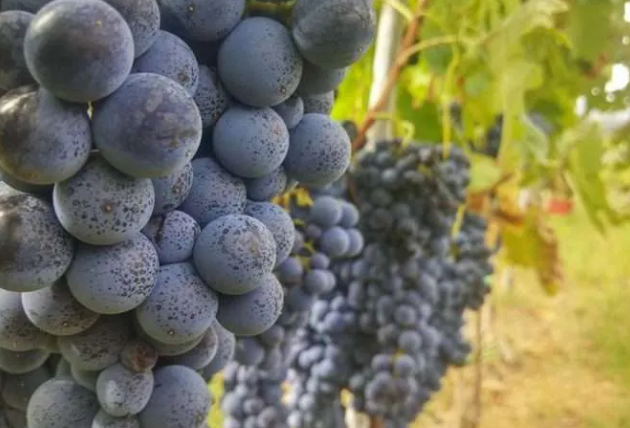
Aglianicone has spent its whole existence in someone else’s shadow. With Aglianico looming over every conversation about red grapes in Campania and Basilicata, a variety whose name means roughly “big Aglianico” was never going to get a fair hearing. Yet it is a genuinely distinct grape with real quality, and in the Val Calore of southern Salerno it accounts for an estimated ninety per cent of the red grapes planted.
Origins and history Aglianicone was first recorded by Acerbi in 1825 and for a long time was assumed to be a sub-variety of Aglianico, picking up names such as Aglianico Femmina and Aglianichello along the way. Nineteenth-century descriptions by Froio and Carusi actually point to two different populations, one around Benevento with oval reddish berries and another around Avellino, Caserta and Salerno with round dark-blue ones. In the Avellino and Salerno countryside it was dismissed as Aglianico Bastardo, while around Caserta it was treated as a separate grape entirely and called Aglianico di Caiazzo.
A case of mistaken identity The confusion reached its peak in the 2000s, when one study tied Aglianicone to Aglianico and another concluded it was identical to Tuscany’s Ciliegiolo and unrelated to Aglianico at all. The likeliest explanation is that the DNA work was done on misidentified vines, an atypical Ciliegiolo taken for Aglianicone. The two really do resemble one another in the vineyard, and careless nurseries are known to have sold Ciliegiolo to growers who thought they were buying Aglianicone. The wines, it should be said, could hardly be less alike.
What the name did to it Aglianico’s prestige in Campania was itself a source of muddle. Any grower who found unusually large, Aglianico-like bunches in an old vineyard had every incentive to call them “big Aglianico”, and a good deal of what is labelled Aglianicone today is nothing of the sort. True Aglianicone is most reliably found in the Beneventano, where the vines show clear morphological differences from Aglianico biotypes. Much of the Val Calore material long recorded as the Tronto biotype of Aglianico may in fact be Aglianicone.
In the vineyard The variety carries medium-large conical to pyramidal bunches with medium, round berries, looser and larger than Aglianico’s. It is never especially vigorous and suffers from millerandage, so although it sets a good number of bunches its actual yields stay low. Every stage of its cycle runs earlier than Aglianico’s, which matters in a region where Aglianico ripens dangerously late, and its resistance to oidium and botrytis is sound. No certified clones exist.
Appearance and structure The berries accumulate less sugar and hold more acid than Aglianico’s, which gives the wines a slightly lighter frame and a fresher line. On paper the pH and total acidity of the two are close, but in the glass Aglianicone reads as rounder and more immediately appealing. It is still a full-bodied, properly tannic red, simply one that wears its structure with less severity.
Aromatic profile Where Aglianico leads with iron, smoke and bitter dark fruit, Aglianicone is fruitier and markedly less spicy. Expect ripe black cherry and plum, a softer earthy undertone and none of the tarry austerity that makes young Aglianico such hard work. It is a difference of character rather than quality, and it makes Aglianicone far more approachable in its youth.
In the cellar There are no pure DOC bottlings beyond Castel San Lorenzo, so most of what reaches the market is IGT. A handful of producers have begun taking the variety seriously as a monovarietal, among them Tenute del Fasanella, founded in 2003 specifically to work with local natives, and Bruno De Conciliis, one of Campania’s best-known growers. In Basilicata it also turns up as a frizzante rosato.
Key expressions
- Monovarietal IGT reds from the Val Calore and the Cilento.
- Castel San Lorenzo DOC, the one appellation to name the grape.
- Aglianicone rosato frizzante from Basilicata.
- Old-vine parcels in the Beneventano, where the true variety is most reliable.
The question of aging With tannin and acidity close to Aglianico’s, well-made Aglianicone has no difficulty holding five to eight years, and the fruit deepens rather than fades over that span. It does not demand the long wait that serious Taurasi requires, which is arguably the point of it. Drink it in the middle of its life, when the fruit is still generous and the tannins have softened.
At the table The combination of body, fresh acidity and unaggressive tannin makes it a natural with the food of inland Campania and the Cilento, from lamb and grilled meats to aubergine, tomato and hard sheep’s cheeses. It handles chilli and garlic without complaint. Serve it a touch below room temperature to keep its fruit lifted.
Why it matters Aglianicone is a reminder that a grape can be held back by nothing more than its name and its neighbours. Its poor reputation owes less to the wines than to decades of confusion with Aglianico, Ciliegiolo and Tronto, and the small group of producers now bottling it honestly are showing how much was written off. It will never displace Aglianico, but it was never a second-rate variety.