
Avanà
A pale, high-acid Alpine red of the Val di Susa and the French Maurienne.
Avanà is a grape variety most associated in Italy with Valsusa.
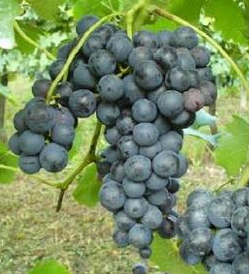
Avanà is the most important variety of the Valle di Susa, the cool mountain country west of Turin on the French border, and it is behind something Italy makes almost nowhere else: ice wine. In a country full of snow-capped slopes, vino del ghiaccio is neither traditional nor a speciality, which makes this obscure Piedmontese grape stand unexpectedly tall.
Origins and history Documented as Avanato by Croce in 1606, and not to be confused with Avarengo, the variety may have come into Italy from France when Piedmont and Savoy belonged to the same kingdom, or it may have travelled the other way. Since it is more common in Italy than in France today, Avanà is treated as an Italian native. The name derives from the Latin abante, meaning forward, most likely a reference to its early ripening.
The Hibou question A 2001 study using molecular markers concluded that Avanà is identical to France’s Hibou Noir and Hibou Rouge, agreeing with an observation from the early 1900s but contradicting Galet. D’Agata urges caution: that identity rested on RAPD analysis rather than SSR profiling, and RAPD is too sensitive to reaction conditions to settle a question of varietal identity. Separate parentage work relates Avanà to the Valais grape Amigne and makes it either parent or offspring of Cacaboué, a near-extinct Savoie variety.
A difficult vine Avanà is fragile and disease-prone, very sensitive to peronospora, oidium and grey rot. It does badly in wind, where the berries drop to the ground, and badly in late-season rain, both of which are characteristic of its own Piedmontese home. It needs drought-resistant rootstocks and plenty of sunlight, since its very large round dark berries often ripen asynchronously. At least it ripens relatively early, usually in late September.
Bringing it back Two experimental vineyards were established from 1990, at Chianocco in the lower Susa valley and Chiomonte in the upper. Chianocco was planted in 1993 with thirty-three presumed clones and biotypes, from which two higher-quality pre-clones were selected and replanted at Chiomonte in 2000. One certified clone has since become available, CVT 1, less fertile, vigorous and productive than the others, giving wines that are more structured and higher in alcohol.
Appearance and structure The dry wines are mountain reds of moderate weight, fresh and direct, with the acidity that altitude and early picking preserve. The CVT 1 clone produces something noticeably firmer. This is not a variety that gives density, and the interest lies in its lift and its alpine character rather than in power.
Aromatic profile Red berry fruit dominates, with a fresh herbal and faintly alpine edge that suits the mountain setting. The ice wines are a different proposition altogether, concentrating the fruit into something intensely sweet while the acidity, preserved by the freezing, keeps it from turning heavy.
In the cellar Italian ice wine is labelled vino del ghiaccio and is most often blended from frozen native grapes, with Avanà typically making up around 60 per cent, picked at minus six degrees or colder. That is the variety’s most distinctive use by a wide margin. Dry reds are also made, in the Valle di Susa and the Pinerolese, usually blended with other local natives.
Key expressions
- Vino del ghiaccio, the rare Italian ice wine, roughly 60 per cent Avanà.
- Valle di Susa DOC reds, where it is the leading local variety.
- Pinerolese blends with other alpine natives.
- Wines from the CVT 1 clone, firmer and higher in alcohol.
The question of aging The dry wines are best within three or four years, while the red fruit and herbal lift are intact; they soften rather than develop. The ice wines are the ones that last, their sugar and acidity carrying them a decade or more as the fruit turns towards dried apricot and honey. Very little is made of either.
At the table The dry reds suit the mountain cooking of the Susa valley, cured meats, polenta, braised game and alpine cheeses, and take a slight chill well. The ice wine belongs with blue cheese and fruit desserts, or on its own. Serve the reds around sixteen degrees, the ice wine cold.
Why it matters Avanà is a difficult, fragile grape kept alive by a deliberate programme of clonal selection in two experimental vineyards, and it produces the closest thing Italy has to an ice-wine tradition. Barbera and Freisa are more famous in Piedmont, but they do not do this. For anyone who thinks they have seen what the region can make, the Valle di Susa is the answer.