
Cagnulari
A dark, peppery Sardinian red recovered from near-disappearance in the 1970s.
Cagnulari is a grape variety most associated in Italy with Alghero, Nurra and Romangia.
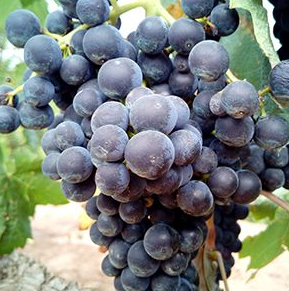
Cagnulari is a Sardinian red from the countryside around Sassari, all but unknown outside the island and the subject of one of the more instructive arguments in Italian ampelography. For years it was declared identical to Bovale Sardo and to Spain’s Graciano, a finding that would have stripped it of its native status altogether. More careful work has since pulled the three apart again.
Origins and history The grape is also called Bastardo Nero, Cada Reio, Caldareddu and Cagliunari. The first of those causes trouble, because Sardinia historically knew another Bastardo Nero, possibly a Cagnulari biotype, perhaps connected to the Bastardo of Spain or the Trousseau of France. Di Rovasenda first described Cagnulari in 1877; Manca dell’Arca, writing in 1780 about the vineyards around Cagliari, never mentioned it, which tells you how confined it already was.
The identity argument Cettolini noted in 1897 that Cagnulari resembled the Bovales, and Bruni, Breviglieri and Casini said the same in 1962; Cara, in 1909, thought it closer to Cannonau and was wrong. The modern claim that Cagnulari, Bovale Sardo and Graciano are one variety rests on a single 2007 microsatellite study published in conference proceedings rather than a peer-reviewed journal. If it held, Cagnulari would be a Spanish import from the four centuries of Spanish rule between 1323 and 1720 rather than a Sardinian native.
How it was resolved Later profiling found that Cagnulari and Bovale Sardo share twenty-three of twenty-four alleles but differ at one locus, VVMD31, and that Bovale Sardo and Graciano share only nineteen of twenty-four. The three cannot all be the same grape. A separate 2010 study likewise failed to show synonymy. What survives is a close relationship rather than an identity, and the reasonable reading is that Cagnulari may be a Bovale Sardo biotype that adapted to the island over centuries.
In the vineyard Cagnulari carries medium-large conical to cylindrical bunches much like Bovale Sardo’s, though its berries are a little more oval and its leaves rounder, usually with three lobes where Bovale Sardo has five. Both ripen late, in October, and both resist the common vineyard pests well, botrytis excepted. Its range is essentially limited to the north-west of the island around Sassari.
Appearance and structure The wine is lighter than its late ripening might suggest, a pinkish-red rather than an opaque one, with a refreshing mid-weight body and real vinosity. It is not built for extraction or heavy oak, and attempts to push it in that direction lose what makes it appealing. The tannins are present but fine-grained.
Aromatic profile Fragrant red-berry fruit leads, raspberry and red cherry, with a fruity, floral charm that makes the wine immediately likeable. There is none of the brooding density of Cannonau or the iron of the mainland southern reds. It is an unusually charming wine for a variety that spent its life as a blending component.
In the cellar Cagnulari is most often blended, usually with Cannonau and Pascale, where it lifts the aromatics and adds freshness. Varietal bottlings are permitted under the Alghero DOC, and the countryside around Usini is generally held to be the grape’s one grand cru. Winemaking is best kept simple, with stainless steel or neutral vessels preserving the fruit.
Key expressions
- Monovarietal Alghero DOC reds, the only appellation permitting 100 per cent Cagnulari.
- Bottlings from Usini, the variety’s acknowledged grand cru.
- Traditional blends with Cannonau and Pascale.
- Old-vine parcels in the countryside around Sassari.
The question of aging This is not a long-distance wine. Cagnulari’s appeal rests on fragrance and freshness, qualities that soften rather than deepen, and three to five years is a fair expectation. The better Usini bottlings will hold longer and gain a savoury, herbal edge, but there is little reward in waiting a decade. Drink it while the red fruit is still vivid.
At the table Its mid-weight and bright acidity make it a natural with Sardinian cooking, from suckling pig and grilled lamb to pecorino sardo and pane carasau. It will also take a light chill, which suits it well in summer. Avoid anything so heavily spiced that it buries the floral character.
Why it matters Cagnulari is a reminder that a single unreplicated study can very nearly erase a grape’s identity, and that the correction rarely travels as far as the original claim. It remains a Sardinian variety of genuine charm, confined to one corner of one island and made in tiny quantity. For anyone interested in what Sardinia grows beyond Cannonau and Vermentino, it is the obvious next stop.