
Chatus
Known in Piedmont as Nebbiolo di Dronero, although it is not related to Nebbiolo.
Chatus is a grape variety most associated in Italy with Colline Saluzzesi.
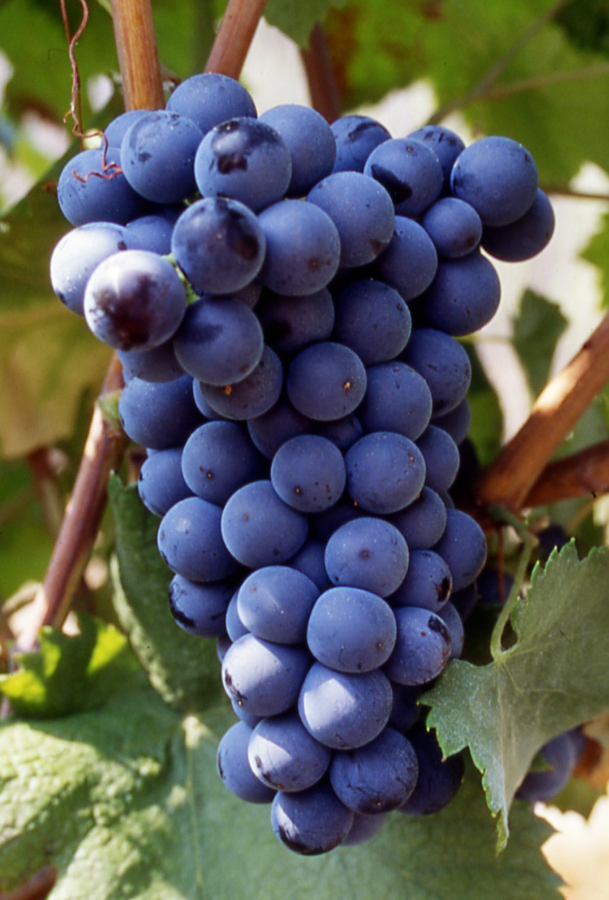
Chatus is the grape behind one of Italian viticulture’s most persistent cases of mistaken identity. For generations it was known in Piedmont as Nebbiolo di Dronero, a name that tied it to a variety it is not related to in any way, and the confusion ran deep enough to reshape the country’s breeding programmes. Growers increasingly use the name Chatus precisely to break that link.
Origins and history Also called Bournin in Piedmontese dialect, the grape answers to Brunetta and Scarlattinin in the Val di Susa and, wrongly, to Brachet in the Canavese, where a genuinely different variety holds that name. Documents from 1268 and 1399 record a Nebiolus grown around Dronero, and since true Nebbiolo was never much planted in that corner of Piedmont, the vine being described was almost certainly Chatus. France’s earliest mention comes only in the 1600s, when Olivier de Serres listed a Chatus among the best varieties of the Ardèche.
Italian or French The question is genuinely open. Chatus grows in the Ardèche and Isère under the same name, and DNA work suggesting that Chatus crossed with Gouais Blanc produced the abandoned French variety Sérénèze de Voreppe would point towards a French origin, since Gouais Blanc is vanishingly rare in Italy. Against that, the documentary record in Piedmont is older, the variety is now nearly extinct in France while surviving in Italy, and it has parented a long line of Italian crossings.
The Dalmasso affair Giovanni Dalmasso, the academic behind many of Italy’s most successful laboratory crossings, crossed what he believed was Nebbiolo with Barbera to produce Albarossa. It was not Nebbiolo but Nebbiolo di Dronero, which is to say Chatus. Later analysis showed that practically every one of Dalmasso’s crossings descends from Chatus rather than Nebbiolo, making it a parent of Albarossa, Cornarea, Nebbiera, Passau, San Martino, San Michele, Soperga and Valentino Nero.
In the vineyard Chatus is vigorous and productive but has poor basal bud fertility, so green harvesting is essential, particularly on the fertile flatland soils where its wines are mediocre at best. It is very sensitive to hail, slightly sensitive to oidium and resistant to grey rot, which makes it otherwise straightforward to grow. A mutation called Nebbiolo Pairolé carries so little bloom that the berries look as black as the bottom of a cooking pot; the same mutation occurs in France as Noir de Maure.
Appearance and structure Chatus does not accumulate large amounts of sugar, so its wines rarely reach high alcohol, which is no disadvantage in a warming climate. What the small berries do carry is a great deal of polyphenol, both anthocyanin and tannin, producing wines of deep, almost purple-black colour and firm structure. Those anthocyanins are unusually stable, so the colour holds for years rather than browning early.
Aromatic profile Pure Chatus is delicately spicy and herbal, with blueberry and prune underneath and a savoury edge. It is spicier and more savoury than Nebbiolo and entirely lacks the red-rose perfume that defines the Langhe variety. Anyone approaching it expecting a Nebbiolo relative will be surprised, which is rather the point of the name change.
In the cellar It is most often blended, with Barbera or Neretta Cuneese, where it contributes body, structure and that durable colour. Local growers regard Nebbiolo as an ideal partner, especially in the Saluzzese where Nebbiolo gives wines lighter in colour than in the Langhe. Today the variety survives in the lower Val Maira and on the hills around Saluzzo and Pinerolo; recent plantings around Largentière and Rozière are reviving it in France.
Key expressions
- Monovarietal Chatus from the hills around Saluzzo and Pinerolo.
- Blends with Barbera or Neretta Cuneese built on its colour and structure.
- Pinerolese DOC reds, where the variety has long played a part.
- Ardèche bottlings from the small French revival.
The question of aging Stable anthocyanins and firm tannin give Chatus a longer life than its modest alcohol suggests, and the better wines hold eight to twelve years without difficulty. The spice and herbal notes deepen while the colour stays remarkably fresh. It is not a wine that needs age to be drinkable, but it rewards a decade more than most Piedmontese reds outside the famous names.
At the table Its savoury spice suits the mountain cooking of the western valleys, and the traditional match is salam d’patata, the potato salami of the Canavesano. It works equally with braised meats, game and the harder alpine cheeses. Serve it at cellar temperature to keep the herbal lift intact.
Why it matters Chatus is a lesson in how much a name can distort. Called Nebbiolo di Dronero, it was misjudged for centuries and quietly rewrote the parentage of eight Italian crossings without anyone noticing. Under its own name it turns out to be a distinctive, deeply coloured, age-worthy mountain red, and one of the few Piedmontese varieties still genuinely waiting to be discovered.