
Cococciola
A brisk Abruzzese white from the Chieti hills, increasingly bottled on its own.
Cococciola is a grape variety most associated in Italy with Abruzzo, Ortona and Terre Abruzzesi.
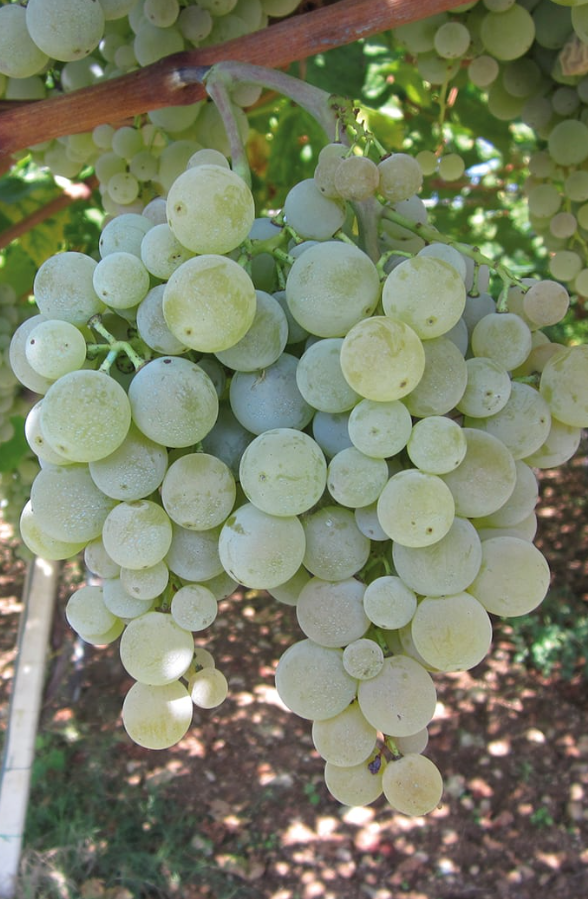
Cococciola was essentially unknown outside its corner of Abruzzo as recently as the 1990s, blended away anonymously into Trebbiano d’Abruzzo for as long as anyone could remember. The revival of interest in native varieties pulled it out, and it turns out to have a real, if delicate, personality of its own. Around eight hundred hectares were planted in Italy as of 2009.
Origins and history Also called Cocacciara and Cacciola, the variety has left little historical trace, appearing in Viala and Vermorel in 1909 and not much before. Its extremely localised distribution suggests it arose either as a spontaneous mutation of an existing vine or as a natural crossing, conceivably involving a local wild grapevine. That is the usual signature of a grape that never travelled.
What it is related to For some time Cococciola was thought to be a biotype of Trebbiano Toscano, which it is not. Recent DNA work instead suggests a relationship with the authentic Bombino Bianco of Puglia. At least three biotypes of Cococciola were identified in 2006, which complicates any tidy account of the variety.
In the vineyard This is an accommodating grape and farmers like it: it ripens early, adapts to unpromising sites, is easy to grow and easy to pick, and yields generously. Its one real weakness is a slightly higher than usual sensitivity to peronospora. The bunch is usually described as cylindrical-conical, though in practice it takes many shapes. Three clones are available, UBA-RA CC 6, UBA-RA CC 31 and 8 ISV, and that degree of selection work says a good deal about local commitment to the variety.
Where it grows Cococciola is concentrated in Abruzzo around Chieti, particularly the townships of Ari, Rocca San Giovanni and Vacri. It is also grown in Molise and in northern Puglia, and many experts think Puglia is where it actually originated. In Molise it stands as one of the region’s two principal natives alongside the red Tintilia.
Appearance and structure The wine is pale straw-green and light on its feet, carried by vibrant acidity and a tactile, almost saline quality. It is not a crowd-pleaser: those accustomed to simpler, rounder whites often do not care for it, precisely because of the herbal, mineral edge that makes it interesting. The texture is its most distinctive feature.
Aromatic profile Menthol and lemon dominate, an unusual and immediately recognisable pairing, with a herbal quality running underneath and a salinity on the finish. There is no tropical fruit and no overt floral character. The menthol note in particular sets it apart from every other Abruzzese white.
In the cellar There are DOC wines permitting Cococciola in both Abruzzo and Puglia, and over a dozen IGTs, with some well-made IGT bottlings that are reportedly pure Cococciola. Reductive handling and stainless steel suit it, since the appeal lies in the aromatic precision. One caveat applies: now that the variety has become popular a great many new bottlings have appeared, and quality is uneven.
Key expressions
- Pure IGT Cococciola from the Chieti hills.
- Abruzzo DOC whites where the variety is named.
- Molise bottlings, where it is one of two principal natives.
- Northern Puglian wines, from what may be the variety’s home ground.
The question of aging Cococciola belongs to the first two years after the vintage, when the menthol and lemon are sharp and the salinity clean. It has enough acidity to survive longer, but nothing develops with time and the herbal character turns coarse rather than complex. There is no reason to cellar it.
At the table Its acidity and saline grip make it very good with oysters and raw shellfish, and one of its best producers also recommends it with white-meat casseroles, which suits the wine’s texture better than its weight would suggest. It handles fried fish and vegetable dishes easily. Serve it cold, around eight degrees.
Why it matters Cococciola is a straightforward illustration of what the native-grape revival was actually for. A variety that existed only as anonymous volume in someone else’s blend turns out to make a distinctive, saline, mentholated white that nothing else in Italy quite resembles. The risk now is the opposite of obscurity, since the name sells faster than the good versions can be made.