
Enantio
An Adige valley red unusually close to the wild vine, long called Lambrusco a Foglia Frastagliata.
Enantio is a grape variety most associated in Italy with Casteller, Valdadige Terradeiforti and Vallagarina.
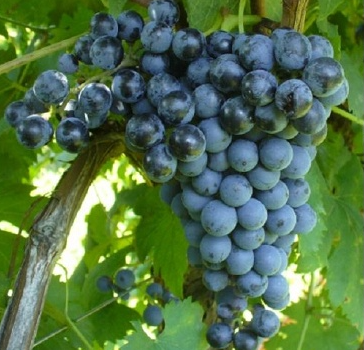
Enantio is the red grape of the Terra dei Forti, the stretch of the Adige valley between Monte Baldo and the Lessinia where Trentino meets the Veneto. For most of its history it has been called Lambrusco a Foglia Frastagliata, the Lambrusco with the jagged leaf, and it is genetically nothing to do with the Lambruscos of Emilia. Its survival rests on a small association of growers and one vineyard of ungrafted centenarian vines.
A contested name Producers wanted a name that separated the variety from the Lambruscos, and Enantio was proposed by Mario Fregoni of the Università Cattolica in Piacenza, in reference to a vine named by Pliny the Elder. It has not entirely caught on; many locals still say Lambrusco a Foglia Frastagliata, others regard Enantio as a marketing device, and the National Registry was still listing the old name as recently as 2012. Sbeccàa, Zicolada and Nostram de Avi are further synonyms.
Origins and history Enantio has been grown for centuries in the low Vallagarina, and by the end of the 1800s Trentino was producing over thirteen thousand hectolitres a year of it, mostly around Ala and Avio. As late as the 1950s, Enantio and Casetta together accounted for more than 60 per cent of all vines planted along the Adige from Avio down to Rivoli. Acerbi was the first to distinguish it clearly from the other Lambruscos, in 1825, which was no small feat given that at least 107 varieties are phenotypically very similar to it.
What it is related to Early work related Enantio to Marzemino, Teroldego and other Trentino varieties, and later research found it to be either a parent or the progeny of Negrara Trentina. That relationship makes the tidy theory, that a Lambrusco carried up from Emilia mutated into Enantio, very unlikely. One group has argued it came instead from the domestication of local wild vines, though the evidence is not yet conclusive; other work has ruled out a Veneto origin.
The vineyard that was saved Luigi Spagnolli of the Vilar estate founded I Dolomitici with ten other small wineries among the region’s best, and the association rented a small plot of centenarian Enantio vines from new owners who intended to pull them out and plant something else. The vines are still ungrafted: the sandy soil near the Adige at Avio never allowed phylloxera to establish. The wine from them is bottled as Ciso, after the former owner’s nickname, and the association is funding work to preserve the variety’s intravarietal diversity.
In the vineyard The jagged, heavily indented leaf that gave the grape its older name is the easiest identifier. Bunches and berries are medium-sized, the bunches usually carrying one or two wings and never tightly packed. It is vigorous and reliably productive, very resistant to both disease and frost, and does best on gravelly-sandy soils in drier microclimates. One official clone exists, SMA-ISV 317.
Appearance and structure The wine is bright and juicy with a sneaky concentration that the first impression does not prepare you for. Acidity is very good and the mouthfeel distinctly richer than most Lambrusco wines, which is the clearest practical argument for separating it from that family. A slightly herbal note closes the finish.
Aromatic profile Red berries lead, with a delicate herbal character woven through rather than laid on top. There is none of the overt frothy fruitiness associated with Emilian Lambrusco, and the wine reads as a serious if unpretentious mountain red. The herbal edge intensifies on the gravelly sites.
In the cellar Two DOCs carry it: Valdadige-Terre dei Forti Enantio for the varietal wine and Valdadige-Terre dei Forti Rosso, where it is blended. Most production is still, unlike its Emilian namesakes, and the best wines come from low yields on the sandy river soils. The ungrafted old-vine bottlings are made in tiny quantity.
Key expressions
- Valdadige-Terre dei Forti Enantio DOC, the varietal benchmark.
- Ciso, from the rescued ungrafted centenarian vineyard at Avio.
- Valdadige-Terre dei Forti Rosso, where it anchors a blend.
- Old-vine wines from the gravelly-sandy soils along the Adige.
The question of aging Enantio carries more acidity and more substance than its family name suggests, and the better bottlings hold six to eight years comfortably, the red fruit giving way to a savoury, herbal register. It is not a wine that demands age, and the everyday versions are best inside three years. The old-vine wines reward patience most.
At the table The acidity and moderate weight suit the cooking of the Adige valley, from cured meats and polenta to braised beef and alpine cheeses. It is versatile enough to handle both lighter dishes and richer ones without dominating either. Serve it around sixteen degrees.
Why it matters Enantio shows how much rests on a handful of people paying attention at the right moment. A variety that made thirteen thousand hectolitres a year in the 1890s was reduced to the point where its oldest surviving vineyard needed rescuing from the plough by a group of growers clubbing together. That those vines are ungrafted makes them close to irreplaceable.