
Casetta
A rare Adige valley red recovered from a few surviving rows in the 1980s.
Casetta is a grape variety most associated in Italy with Valdadige Terradeiforti and Vallagarina.
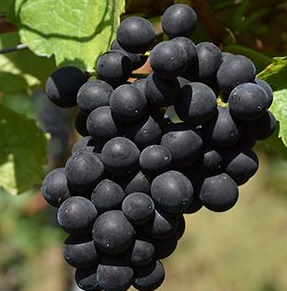
Casetta is a Trentino red that went from five thousand hectolitres a year in the 1890s to fewer than fifteen hectares, uprooted in the late twentieth century so the Vallagarina could plant Cabernet Sauvignon, Carmenère and Syrah. None of those ripens especially well in Trentino’s cool northern climate. The native they replaced does.
Origins and history The name means little house, and probably records the very human habit of bringing wild vines in from the woods to grow near the home. It is also rarely called Maranela, after the eighteenth-century Marani family of Ala, who were the first to try it in their vineyards. In dialect it is Foja Tonda, which should not be confused with Tuscany’s distinct Foglia Tonda.
Not a Lambrusco Casetta was long counted among the Lambruscos, and carries synonyms such as Lambrusco a Foglia Tonda and Lambrusc’Avio, but it has been shown genetically distinct from that family. It does resemble Enantio, the variety known as Lambrusco a Foglia Frastagliata, a similarity Acerbi noticed as early as 1825. The two were the mainstays of the Adige valley together.
In the vineyard The round leaf, with almost no indentations or sinuses, is the distinguishing feature; bunches are medium-small and the berries small and nearly oval. Budbreak is early, which exposes it to spring frost, though the vine itself is very cold-resistant. It is sensitive to grey rot but resistant to peronospora and oidium, and that grey rot susceptibility is largely what sealed its fate when growers were looking for reasons to replant. No clones exist.
An unusual combination Casetta manages something most varieties cannot: it accumulates high sugar concentrations while retaining high total acidity, and it gives wines of genuinely deep colour. That trio is exactly what a grower in a cool climate should want, which is what makes the replanting decisions of the 1980s and 1990s look so poor in hindsight.
The rescue Albino Armani was the first to believe in the variety and act. In 2003 he created the Conservatoria, a small experimental vineyard at Dolcè planted to Vallagarina cultivars facing extinction, Casetta among them, after finding a few hundred-year-old vines. Through the 1990s he worked with the Istituto di San Michele all’Adige and with Tiziano Tomasi of the Cadalora estate to bring the variety back. Casetta was only permitted for cultivation again in 2002.
Appearance and structure There is plenty of tannin and structure, yet the wine reads as medium-bodied and fresh, lighter than it actually is, because of the sheer volume of vibrant acid. Whether that appeals depends entirely on how you feel about high-acid reds. It takes judicious oak well, which rounds it into something smoother and richer.
Aromatic profile Bright red fruit leads, with a vinous, grapey directness, and after two or three years the wine picks up tobacco and mineral notes. That said, it is not built to age, and the open question is how much complexity it can ultimately develop. As commercially available bottlings accumulate years, that question will answer itself.
In the cellar Casetta grows mainly on the right bank of the Adige around Avio, Ala and Rovereto, and also in the Veneto near Verona and around Brentino and Belluno. The wines to look for are the Terre dei Forti DOC, created only in 2006, and IGT blends under Delle Venezie, Vallagarina and Vigneti delle Dolomiti. Albino Armani remains the only producer of a commercial monovarietal, with a first vintage in 1994.
Key expressions
- Terre dei Forti DOC, the appellation that finally named the variety.
- Albino Armani’s monovarietal, the only one made commercially.
- IGT Vallagarina and Vigneti delle Dolomiti blends.
- Fruit from the Conservatoria at Dolcè, planted from centenarian vines.
The question of aging D’Agata is direct: this is not a wine meant to age. Two or three years bring tobacco and minerality alongside the red fruit, and that is the sweet spot. The oaked versions hold longer and smooth out, but the acidity, not the tannin, is what carries Casetta, and freshness is the point.
At the table The high acidity makes it unusually good with the fatty cooking of the Adige valley, from speck and cured meats to polenta, braised game and alpine cheeses. It cuts through richness where a softer red would be swamped. Serve it around sixteen degrees.
Why it matters Casetta is the clearest indictment of the international-variety craze in northern Italy: a high-quality native with the rare gift of high sugar and high acidity together, torn out for Bordeaux grapes that struggle to ripen there. Fifteen hectares and one committed producer are what stand between it and extinction. The wines argue it was worth saving.