
Franconia
Blaufränkisch under its Italian name, in Lombardy and Friuli since the 1800s.
Franconia is a grape variety most associated in Italy with Terre del Colleoni.
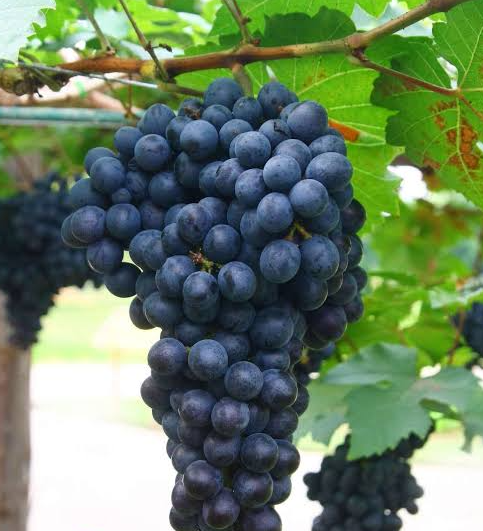
Franconia is the Italian name for Blaufränkisch, the great red grape of Austria and one of central Europe’s most serious varieties. It has been grown in Friuli for centuries, long enough to be treated locally as part of the furniture, and it makes a lighter, fresher wine there than it does in Burgenland. Neither of the standard books on Italian native grapes covers it, for the obvious reason that it is not one.
Origins and identity The variety is Blaufränkisch in Austria, where it is also called Limberger or Lemberger, and it arrived in Friuli from Austria during the long period when the north-east of Italy looked to Vienna rather than Rome. It should not be confused with Frankisch as a general German term for quality grapes, nor with Franconia the German wine region, which grows almost none of it.
A long residency Franconia has been cultivated in Friuli for centuries and is thoroughly established there, which is why it holds a place in appellation law rather than existing as a curiosity. It is a traditional rather than native variety, the same category Italian ampelography assigns to Chatus, Ottavianello and a number of other grapes that arrived early enough to have become local in everything but ancestry.
Where it grows Italian plantings are concentrated in Friuli-Venezia Giulia, particularly the Tagliamento plain between Cervignano and Palmanova, with smaller quantities in the hills. It is also grown in Trentino around Levico. Across the regional border it is permitted in the Lison-Pramaggiore DOC, and in Friuli it has its own designations, among them Friuli Isonzo Franconia.
In the vineyard Sugar accumulation runs from around 17 to 19 per cent depending on the site, and total acidity varies widely with it, between 5 and 9 grams per litre. That range is the practical story of the grape in Italy: on the warm Tagliamento plain it ripens readily and gives softer wine, while cooler hillside sites preserve the acidity that makes the variety interesting further north.
Appearance and structure Friulian Franconia is typically a deep ruby, lighter in body than its Austrian counterpart, with crisp drinkability, good acidity and restrained structure. The tannins are light and soft rather than the firm, mineral grip that defines top Burgenland Blaufränkisch. It is built for drinking young and behaves accordingly.
Aromatic profile Violet leads the floral register, over cherry and raspberry, usually with a spicy note behind them. That combination is recognisably Blaufränkisch, simply pitched lower and fresher than in Austria. There is none of the graphite and dark-fruit density that the variety reaches on the best Leithaberg sites.
In the cellar Most Friulian Franconia is made for early drinking in stainless steel or neutral vessels, which suits the light tannins and preserves the floral lift. A handful of producers age it in wood and push for more structure, with mixed results: the variety in Italy rarely carries oak comfortably. Restraint is the more convincing approach.
Key expressions
- Friuli Isonzo Franconia DOC, the clearest varietal expression.
- Lison-Pramaggiore DOC reds across the Veneto border.
- Hillside bottlings from the Colli Orientali, with more acidity.
- Trentino wines from around Levico, the variety’s other Italian outpost.
The question of aging Italian Franconia is made to be drunk young and the light tannins offer little to age on; three to five years is realistic, and the floral aromatics fade first. This is the sharpest contrast with Austria, where good Blaufränkisch will run fifteen years or more. The grape has the capacity; the Friulian style mostly declines to use it.
At the table Its freshness and soft tannins suit the cooking of the Friulian plain: frico, cured pork, goulash-influenced stews, roast poultry and Montasio. A slight chill does it no harm at all. Serve it around sixteen degrees.
Why it matters Franconia is a reminder that Italy’s north-east spent centuries facing the other way, and its vineyards still record that. It also raises an unanswered question: one of central Europe’s most ageworthy red grapes has been in Friuli for centuries and is almost entirely made as a light, early-drinking wine. Whether that is the terroir or simply the habit has not really been tested.