
Bianco d’Alessano
The Valle d’Itria white that supplies body — half the formula for Locorotondo.
Bianco d’Alessano is a grape variety most associated in Italy with Gravina, Locorotondo, Martina Franca and Tarantino.
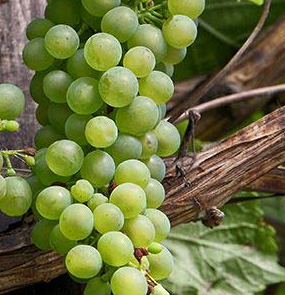
Nobody is going to mistake Bianco d’Alessano for the second coming of Riesling, and D’Agata says as much. It is the workhorse white of the Valle d’Itria, planted alongside Verdeca for centuries and rarely allowed to stand alone. The argument for it is that nobody has really tried: drop the yields and the grape has more to offer than its reputation allows.
Origins and history The record is thin, with no real information before 1870, when the variety was first mentioned. It is probably original to the Valle d’Itria in Puglia, and also answers to Acchiappapalmento, Bianco di Lessame and Verdurino. In 2008 it was proven identical to the Calabrian variety Iuvarello, and in Calabria it has been cultivated for centuries under the names Iuvarello, Vuiune, Iuvino and Buino.
Always the junior partner Bianco d’Alessano has always been planted promiscuously with Verdeca, and it has always lost the comparison. Verdeca has the delicate aromatic quality, the higher productivity and the vivid green colour, and on its own Bianco d’Alessano is non-aromatic and can be watery and neutral. Livio Carparelli makes monovarietal wines from all three local whites, and tasting them side by side shows Bianco d’Alessano to be the least complex of them.
In the vineyard The variety has conical-cylindrical bunches and round berries, and ripens between late September and early October. Budding and flowering are relatively early, which exposes it to both spring frost and coulure, the berry shatter that follows when cool, wet or abnormally hot weather at flowering prevents fertilisation. Two promising clones arrived in 2010, CRSA-Regione Puglia C2 and C5, the latter more loosely packed and more disease-resistant.
Built for heat Whatever it lacks in complexity, Bianco d’Alessano is hardy and undemanding, and it withstands very hot, arid conditions of the kind Puglia reliably provides. That single quality explains both its historic popularity and a new interest in it: warm-climate regions including parts of California and Australia have begun looking at the variety precisely because of its heat tolerance.
Where it grows Plantings sit mainly in the provinces of Brindisi, Bari and Taranto, around the Valle d’Itria towns of Cisternino, Locorotondo, Martina Franca and Ceglie Messapica, and across the high, barren, wind-swept Murgia on the border with Basilicata. The long-recognised grand cru is the Gallinajo subzone of Locorotondo. It also grows in Calabria under its other names.
Appearance and structure The wine is light and non-aromatic, and its quality depends almost entirely on yield. At the volumes Puglia has traditionally asked of it, it is thin. At restrained yields it gains a modest but genuine character, more textural than aromatic, which is what the small number of varietal bottlings demonstrate.
Aromatic profile A pure Bianco d’Alessano is delicately herbal, with green apple, bitter orange and white flowers. The bitter orange note is the most distinctive thing about it. None of this is emphatic, and the wine asks for a certain amount of attention that its price rarely encourages.
In the cellar The most important wine is Locorotondo DOC, where it is blended with Verdeca, and it also appears in the rarer Gravina, Ostuni and Lizzano DOCs and in the Daunia, Murgia, Salento and Valle d’Itria IGTs. Monovarietal bottlings exist but are scarce. Reductive handling and stainless steel preserve what aromatics there are.
Key expressions
- Locorotondo DOC, blended with Verdeca, the classic expression.
- Rare monovarietal bottlings from low-yielding parcels.
- Wines from the Gallinajo subzone, the acknowledged grand cru.
- Calabrian wines made under the Iuvarello name.
The question of aging There is no case for keeping it. Bianco d’Alessano is at its best in the year after the vintage, and the herbal and bitter-orange notes that give it interest fade quickly. The better monovarietal wines hold two or three years without improving. Drink it young and cold.
At the table It suits the cooking of the Valle d’Itria: burrata, orecchiette with greens, grilled vegetables and fresh cheeses, where its herbal edge and light body stay out of the way. It also handles fried food and raw seafood. Serve it cold, around eight degrees.
Why it matters Bianco d’Alessano is a test case for whether the native-grape revival can rescue an average grape as well as a good one. The honest verdict is that it is the third-best white in its own valley. But it is genuinely heat-tolerant at a moment when that is becoming the most valuable trait a vine can have, and that may yet be its future rather than its past.