
Nerello Mascalese
Sicily's answer to Pinot Noir—ethereally pale yet profoundly complex, reaching its apex on the lava soils of Mount Etna.
Nerello Mascalese is a grape variety most associated in Italy with Etna, Faro and Terre Siciliane. I have reviewed 33 wines made from it.
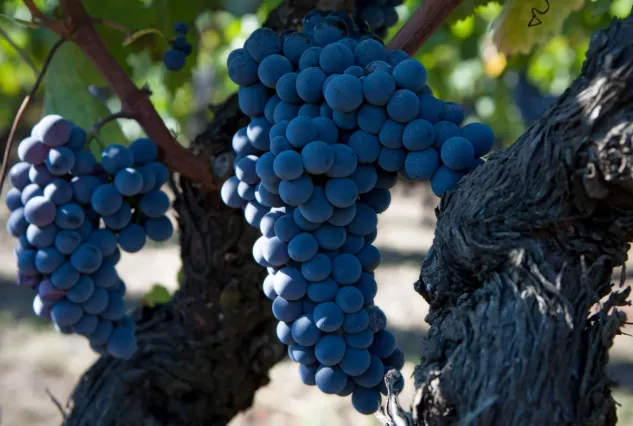
The Grape of the Volcano Nerello Mascalese is the noble red grape of Mount Etna, and in the space of a generation it has gone from obscure regional variety to one of the most fashionable red grapes in the world. Grown on the black volcanic slopes of Sicily’s active volcano, it produces wines of such elegance and transparency that they are routinely — and revealingly — compared to red Burgundy and Barolo.
A Sicilian Native Named for the Mascali plain at the foot of Etna, Nerello Mascalese is an ancient Sicilian variety, shown by DNA research to be a natural crossing of Sangiovese and Mantonico Bianco, which also makes it a sibling of Gaglioppo. It ripens very late — often well into October — and demands the long, sun-drenched autumns of the Sicilian south to reach maturity, even as the altitude of Etna keeps its acidity bright.
Appearance and Structure Like Nebbiolo, Nerello is pale and deceptive: light garnet in the glass, fragrant and delicate to the eye, yet structured by fine, persistent tannins and vivid acidity. It is the antithesis of the dark, jammy reds once expected of southern Italy — ethereal, mineral and savoury.
Aromatic Profile The signature is red cherry, wild strawberry and pomegranate lifted by dried herbs, blood orange, crushed stone, smoke and a distinctive ferrous, volcanic minerality. With age it develops notes of dried rose, tar, orange peel and forest floor — an aromatic complexity that explains the Burgundy and Barolo comparisons.
A Grape Defined by Altitude and Lava No grape is more transparently a product of its terroir. On Etna, Nerello is grown in contrade — named lava flows at different altitudes and from different eruptions — each imparting a distinct mineral fingerprint. Vines are often ungrafted and astonishingly old, some over a century, having survived phylloxera in the sandy volcanic soils, and trained as low alberello bush vines on steep terraces.
In the Cellar The modern Etna style favours restraint: gentle extraction, neutral or large-format oak, and minimal intervention to preserve the wine’s delicacy and sense of place. It is frequently blended with a small proportion of the softer, darker Nerello Cappuccio, and is also the basis of Etna Rosato, one of Italy’s finest rosés.
Key Expressions
- Etna Rosso: the benchmark — pale, perfumed, mineral reds from the volcano’s northern and eastern slopes, increasingly bottled by individual contrada.
- Single-contrada bottlings: site-specific wines that express the altitude and lava flow of a named cru, the Etna answer to Burgundy’s climats.
- Etna Rosato: structured, savoury, gastronomic rosé.
The Question of Aging Though delicate in appearance, top Nerello Mascalese ages with grace for a decade or two, its acidity and fine tannin preserving the fruit while the wine gains tertiary notes of dried flowers, tar and orange rind. The best contrada wines are now treated as serious cellar candidates.
At the Table Its bright acidity and moderate tannin make it wonderfully versatile: grilled fish and tuna, roast pork, mushroom and herb dishes, Sicilian caponata, and medium-aged cheeses. It bridges the gap between red and white wine roles at the table.
The Contrada Revolution Perhaps the most exciting development in Italian wine this century has been the mapping of Etna’s contrade — the individual lava flows and named parcels that ring the volcano at different altitudes. Pioneering growers, many arriving from outside Sicily, recognised that these sites express terroir with a precision worthy of Burgundy’s climats, and began bottling them separately. The result has been an explosion of single-contrada Nerello Mascalese that has redrawn the map of fine Italian red wine, turning a once-forgotten volcanic backwater into one of the most closely studied and admired terroirs on earth.
Why It Matters Nerello Mascalese is the grape that rewrote the story of southern Italian wine. It proved that Sicily could produce reds of finesse, minerality and ageworthiness to rival the great names of the north — and made Etna one of the most exciting and closely watched terroirs on earth.
Reviews for Nerello Mascalese
Show 24 more reviews
- 2024 Frank Cornelissen “Munjebel”94
- 2022 Frank Cornelissen “Munjebel Mc” Terre Siciliane Rosso97
- 2022 Frank Cornelissen “Munjebel Cd” Terre Siciliane Rosso94
- 2022 Frank Cornelissen “Munjebel Cr” Terre Siciliane Rosso94
- 2022 Frank Cornelissen “Munjebel Cs” Terre Siciliane Rosso95
- 2022 Frank Cornelissen “Munjebel Va” Terre Siciliane Rosso96
- 2022 Frank Cornelissen “Magma” Etna Rosso99
- 2021 Masseria Setteporte Etna Rosso90
- 2023 Planeta Etna Rosso94
- 2022 Tenuta delle Terre Nere ‘Anniversario – Calerara Sottana’ Etna Rosso97
- 2023 Tenuta delle Terre Nere ‘Guardiola’ Etna Rosso98
- 2023 Tenuta delle Terre Nere ‘Santo Spirito” Etna Rosso95
- 2023 Tenuta delle Terre Nere ‘Prephylloxera” Etna Rosso97
- 2024 Tenuta delle Terre Nere Etna Rosso92
- 2023 Quantico Etna Rosso94
- 2023 Passopisciaro Contrada G Etna Rosso98
- 2024 Passopisciaro Etna Rosso95
- 2023 Passopisciaro Contrada R Etna Rosso97
- 2023 Passopisciaro Contrada C Etna Rosso95
- 2023 Passopisciaro Contrada S Etna Rosso96
- 2022 Le Casematte “Peloro” Rosso Terre Siciliane94
- 2022 Tenuta delle Terre Nere Etna Rosso95
- 2018 Planeta Eruzione 1614 Nerello Mascalese Etna Rosso93
- 2015 Calabretta Nerello Mascalese Vigne Vecchie Terre Siciliane95