
Riesling Italico
Welschriesling — no relation to Riesling, despite the name it carries in Italy.
Riesling Italico is a grape variety most associated in Italy with Bianco di Pitigliano, Colli del Trasimeno, Colli Pesaresi and Custoza.
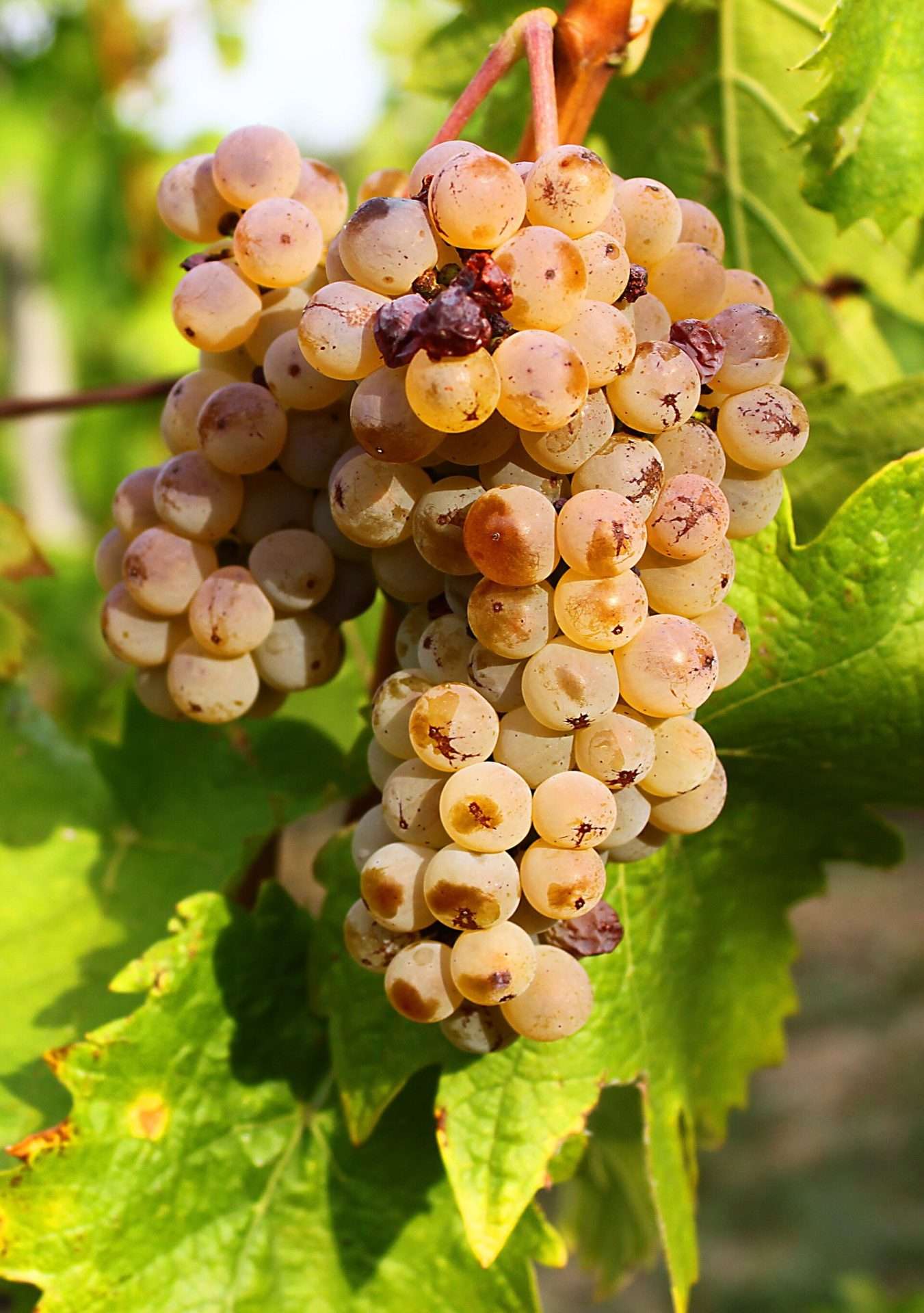
Riesling Italico is not Riesling. It is Welschriesling, a variety with no relationship whatever to the great German grape, and the name has caused more confusion than almost any other in European wine. Italian appellation law is clear about it where the label often is not, listing Riesling Renano and Riesling Italico as two separate permitted varieties.
A misleading name The italico in the name means Italian, and the pairing with Riesling implies a kinship that does not exist. The same grape is Welschriesling in Austria, Gráševina in Croatia, Olaszrizling in Hungary and Laski Rizling in Slovenia, and in each case the local name attaches it to a foreign Riesling it is unrelated to. Buyers have been misreading it for well over a century.
Where it sits genetically Scienza’s genealogical work places Riesling Italico among the offspring of Coccalona Nera, which makes it a half-sibling of Barbera, alongside Uva Rara, Moscato Nero d’Acqui and Vespolina. Several of those have long been cultivated in the Oltrepò Pavese, which is also where Riesling Italico is most at home in Italy. It is, on that evidence, a good deal more Italian than its name suggests, and not remotely a Riesling.
Where it grows Riesling Italico is planted across northern Italy and named in appellation rules throughout Lombardy, the Veneto and Piedmont. In several DOCs it appears explicitly alongside Riesling Renano, sometimes with the two permitted interchangeably up to a high percentage of the blend, which is how a great deal of Italian Riesling ends up being neither one thing nor the other on the shelf.
In the vineyard It is a reliable, productive variety that ripens later than Riesling Renano and holds acidity well, which is the main reason it earned its place in the north. It suits the cooler hillside sites of the Oltrepò Pavese and the Veneto foothills. Cropped hard, as it often has been, it gives neutral wine; restrained, it gives something with genuine cut.
Appearance and structure The wines are light to medium-bodied with firm acidity and a clean, direct line. They lack the intensity, the structure and above all the ageing capacity of true Riesling, which is the honest comparison and the one the name invites. Within their own terms they are well-balanced dry whites.
Aromatic profile Green apple, citrus and white flowers lead, with a faint almond note on the finish that is the variety’s most recognisable marker. There is none of the lime, slate or petrol development that defines Riesling Renano with age. The aromatics are gentle and fade rather than evolve.
In the cellar Stainless steel and early bottling preserve what the grape offers. Its acidity also makes it a useful base for sparkling wine, particularly in the Oltrepò Pavese, where much of Italy’s traditional-method production is concentrated and where a neutral, high-acid white has obvious value. Most of it, though, goes into everyday still blends.
Key expressions
- Oltrepò Pavese whites, where it is long established.
- Veneto and Lombardy DOC blends naming it alongside Riesling Renano.
- Sparkling base wines built on its acidity.
- Low-yield varietal bottlings, where the almond note comes through.
The question of aging This is the sharpest difference from the grape it is named after. Riesling Italico is at its best within two or three years and does not develop; the fruit simply recedes and the almond note turns bitter. Anyone cellaring it on the strength of the word Riesling will be disappointed, which is a mistake the name has been causing for generations.
At the table Its acidity and light body suit freshwater fish, risotto, fresh cheeses and the lighter cooking of the Po valley, and it handles fried food well. It is an unfussy everyday white and works best treated as one. Serve it cold, around eight to ten degrees.
Why it matters Riesling Italico is the most consequential naming problem in Italian wine: a competent, unrelated variety that has spent a century borrowing and damaging the reputation of a far greater one. Untangling it matters for buyers, and the genetics are the real surprise, placing it as a half-sibling of Barbera rather than anywhere near the Rhine.