
Moscato d’Alessandria
Grown in Sicily as Zibibbo and used in the celebrated Passito di Pantelleria—a richly sweet, orange-blossom grape of ancient Mediterranean origin.
Moscato d’Alessandria is a grape variety most associated in Italy with Pantelleria.
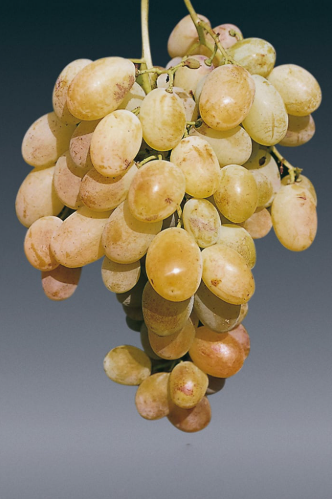
Moscato d’Alessandria and Zibibbo are the same grape, known internationally as Muscat of Alexandria. The full guide lives on the Zibibbo page, which is the name used on Pantelleria and throughout Sicily.
Where the names come from Moscato d’Alessandria records the variety’s presumed origin in the eastern Mediterranean. Zibibbo comes from the Arabic zabib, meaning raisin, which is a fair description of what Pantelleria has always done with it: dry the grapes in the sun and make passito. The Arabic name is the older and more useful of the two in Italy.
An unusually productive parent This grape has left a long line of descendants. It is one of the two parents of Malvasia del Lazio, crossed with Schiava Grossa, and shares a parent-offspring relationship with Moscato Bianco. It also stands close to Minutolo, whose Muscat kinship is what finally established it was never a Fiano.
Telling it from Moscato Bianco The two are routinely confused, on labels and in books. Moscato d’Alessandria gives wines that are oilier and fuller-bodied, where Moscato Bianco is lighter and fresher. Anyone tasting a Muscat that seems unexpectedly rich and unctuous is probably drinking this one.
For history, viticulture, Pantelleria and the wines in full, see Zibibbo.