
Petit Verdot
A late-ripening Bordeaux variety finding surprising success in Tuscany and Puglia, where it adds deep color, violet aromas, and firm structure to blends.
Petit Verdot is a grape variety most associated in Italy with Bolgheri and Maremma Toscana. I have reviewed eight wines made from it.
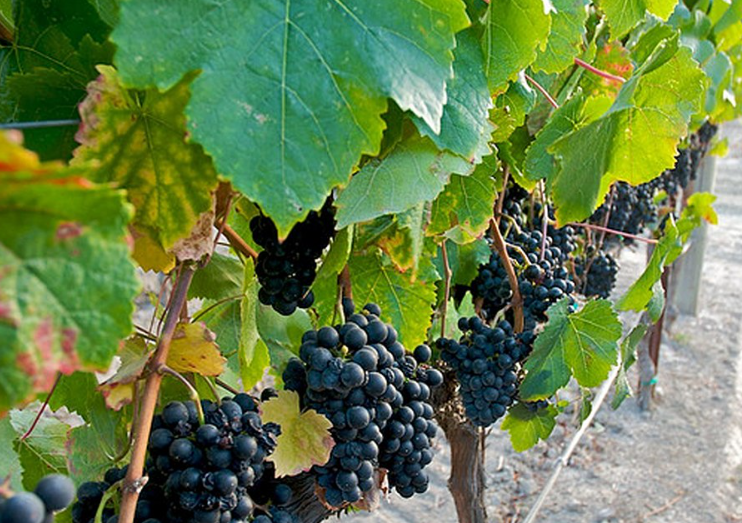
The Bordeaux Spice Grape Petit Verdot is a classic Bordeaux variety traditionally used in small amounts to add colour, tannin, spice and structure to a blend. Late-ripening and demanding, it struggles in its cool homeland but flourishes in the warmth of central and southern Italy, where it reliably ripens and has found a new and increasingly important role — both as a blending grape and, more and more, as a characterful varietal wine in its own right.
A Bordeaux Native One of the oldest grapes of the Médoc, Petit Verdot is older even than Cabernet Sauvignon, the variety it traditionally supports. Its name means “little green one,” a reference to its small berries and to its habit of failing to ripen in cool years, when its grapes stayed green and unusable. This unreliability long confined it to a tiny supporting role in Bordeaux, where many estates eventually grubbed it up.
A Grape Transformed by the Sun Petit Verdot’s Italian story is one of climate. What is a difficult, often unripe afterthought in Bordeaux becomes, under the reliable Mediterranean sun of Bolgheri, Sicily, Puglia and Lazio, a generous and fully expressive variety. This warmth-driven reliability has made it a favourite of producers seeking depth of colour, firm structure and exotic spice, whether for blending or for varietal wines.
Appearance and Structure Petit Verdot gives deeply coloured, near-opaque wines with firm, substantial tannins and good acidity — a powerful, structured grape built for ageing. Even in small proportions it darkens and firms a blend; as a varietal, fully ripe, it produces bold, concentrated reds of real presence, grip and longevity.
Aromatic Profile The signature is dark fruit — blackberry, black plum and blueberry — with pronounced notes of violet, black pepper, dried herbs, liquorice and a savoury, spicy character. Oak ageing adds chocolate, leather and sweet spice, while the grape’s natural perfume and structure give it a distinctive, almost exotic aromatic edge that sets it apart from other Bordeaux varieties.
Where It Thrives in Italy The grape has spread well beyond Bolgheri, where it first proved itself as a Super Tuscan blending component. In the heat of Sicily, Puglia and the Lazio coast it ripens fully and is increasingly bottled as a varietal, while across central Italy it adds backbone and colour to a range of blends. Its drought tolerance and reliable ripening make it well suited to a warming climate.
In the Cellar As a blending grape Petit Verdot is used in small but telling proportions to lend colour, tannin and aromatic lift to Bordeaux-style cuvées. As a varietal it is typically barrique-aged to round its firm tannins and amplify its dark, spicy fruit, producing structured wines designed to reward several years in the cellar.
Key Expressions
- Bolgheri & the Tuscan coast: a structuring, colouring component of Super Tuscan blends.
- Southern Italy (Sicily, Puglia, Lazio): increasingly bottled as a bold, ripe varietal red.
- Bordeaux-style blends: a small but valuable addition for depth, spice and grip.
The Question of Aging Petit Verdot’s firm tannin and deep colour make it naturally age-worthy; the best varietal and blended examples evolve over a decade or more, the dark fruit deepening into leather, tobacco, dried herb and spice as the firm tannins gradually soften.
At the Table Its power and structure call for robust food: grilled and roast red meats, lamb, game, barbecue, peppered and spiced dishes and hard mature cheeses. The grape’s firm grip is best matched by rich, fatty and boldly flavoured fare.
Why It Matters Petit Verdot shows how the Italian sun can redeem a difficult grape: a once-marginal Bordeaux blender that, in the warmth of central and southern Italy, has become a reliable source of colour, spice and structure — and, increasingly, a compelling varietal in its own right.