
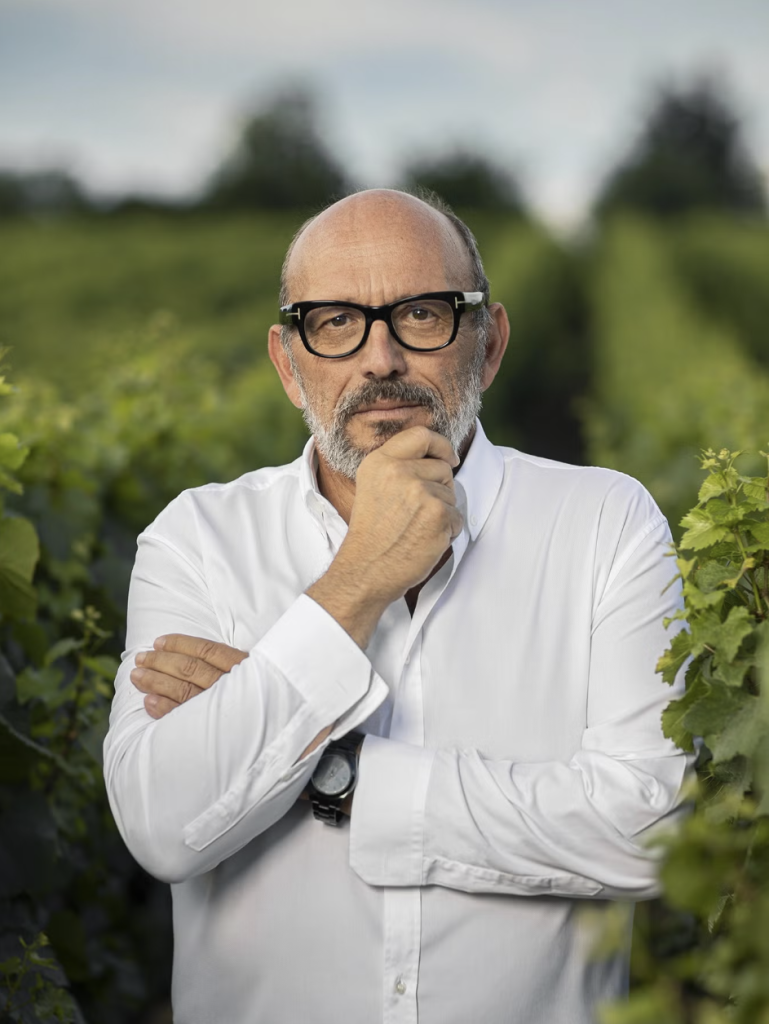
Ca’ del Bosco: The Man Who Built Franciacorta
Ca’ del Bosco isn’t just in Franciacorta. For most of the world, Ca’ del Bosco is Franciacorta. And it all
The still soul of Franciacorta—the geographical indication used by Lombardy's great sparkling wine producers to bottle their prestigious still wines, from Bordeaux blends to structured Chardonnays.

Zones: regional wine-zone data of Piemonte, Toscana, Veneto, Lombardia, Lazio and Bolzano (CC BY / CC0), EU wine PDO boundaries (Candiago et al. 2022, CC0), production rules drawn with ISTAT boundaries; vineyards: Regione Piemonte (CC BY 4.0), Regione Toscana land use 2019 (CC BY 4.0); geology: Regione Toscana DataBase Geologico (CC BY 4.0), Arpa Piemonte - Geoportale / CNR-IGG GeoPiemonte Map 1:250,000 (CC BY 4.0); places: GeoNames (CC BY 4.0), OpenStreetMap (ODbL). Imagery: Powered by Esri — Esri, Maxar, Earthstar Geographics. Terrain: © Mapterhorn.
Official zone boundary · Italian wine map · Regional map (Federdoc) · Imagery: Powered by Esri
“Sebino” is the ancient name for Lake Iseo, whose thermal mass moderates the climate of Franciacorta in central Lombardy. The IGT exists as a creative escape from two restrictive designations: the Franciacorta DOCG (reserved exclusively for Traditional Method sparkling wine) and the Curtefranca DOC (which imposes tight rules on variety blends for still wines). Producers who want to make something outside those rules reach for Sebino.
The Terroir Franciacorta sits on one of the most geologically complex terroirs in northern Italy — the moraine amphitheater left by the Oglio glacier, composed of gravelly glacial debris, clay pockets, and sandy loam at varying depths. The same soils that yield the mineral base for Franciacorta sparkling wines also produce structured, age-worthy still wines when yields are controlled.
The Wines Predominantly Bordeaux-style reds (Cabernet Sauvignon, Merlot, Cabernet Franc) and oak-aged whites (Chardonnay, Pinot Bianco). The most celebrated Sebino IGT is Maurizio Zanella by Cà del Bosco — a Cabernet-Merlot-Franc blend widely regarded as one of Lombardy’s finest reds, rivaling the best Super Tuscans in ambition and longevity. Pure Pinot Nero bottlings also appear, exploiting Franciacorta’s natural affinity for the variety.
The Critical Take The designation is secondary; the wines are primary. Sebino IGT is where the great Franciacorta houses prove that their terroir can do more than bubbles — and in Maurizio Zanella’s case, emphatically so.
Why the IGT Exists Here Franciacorta’s classification system is unusually rigid even by Italian standards. The DOCG name is reserved absolutely for traditional-method sparkling wine, and the still wines of the same vineyards fall under Curtefranca DOC, which prescribes both the permitted varieties and the blend proportions. A producer wanting to bottle a pure Cabernet Sauvignon, a straight Pinot Nero, or a Bordeaux blend in proportions Curtefranca does not allow has exactly one option, and Sebino is it. The consequence is a category holding both serious ambition and ordinary overflow, with nothing on the label to tell them apart. As so often with Italian IGTs, the producer’s name carries all of the information and the classification carries none of it.
At the Table The reds are built for the cooler months and for Lombard cooking: braised beef, casoncelli, roast game, and aged Bagoss or Grana. Decant the Cabernet-based wines and serve them at 17–18°C. The oaked whites handle lake fish, risotto and poultry, and want 12–13°C rather than the fridge-cold service the region’s sparkling wine has trained everyone to expect.
Benchmark Producers Cà del Bosco (Maurizio Zanella), Bellavista, Bosio.
Ca’ del Bosco isn’t just in Franciacorta. For most of the world, Ca’ del Bosco is Franciacorta. And it all
Zanella’s original dream was also inspired by Bordeaux. This is his personal red wine, a “Super-Franciacorta” blend of Cabernet Sauvignon,
2020 Ca’ del Bosco Maurizio Zanella Rosso Del Sebino IGT Read Post »
When people hear Ca’ del Bosco, they think of their legendary Franciacorta, but for me, the true insider’s wine is
2020 Ca’ del Bosco “Bosco Selva Della Tesa” Chardonnay Sebino IGT Read Post »