
Malvasia di Candia
The high-yielding Malvasia whose dominance cost Frascati its reputation.
Malvasia di Candia is a grape variety most associated in Italy with Bianco Capena, Castelli Romani, Colli Albani and Frascati.
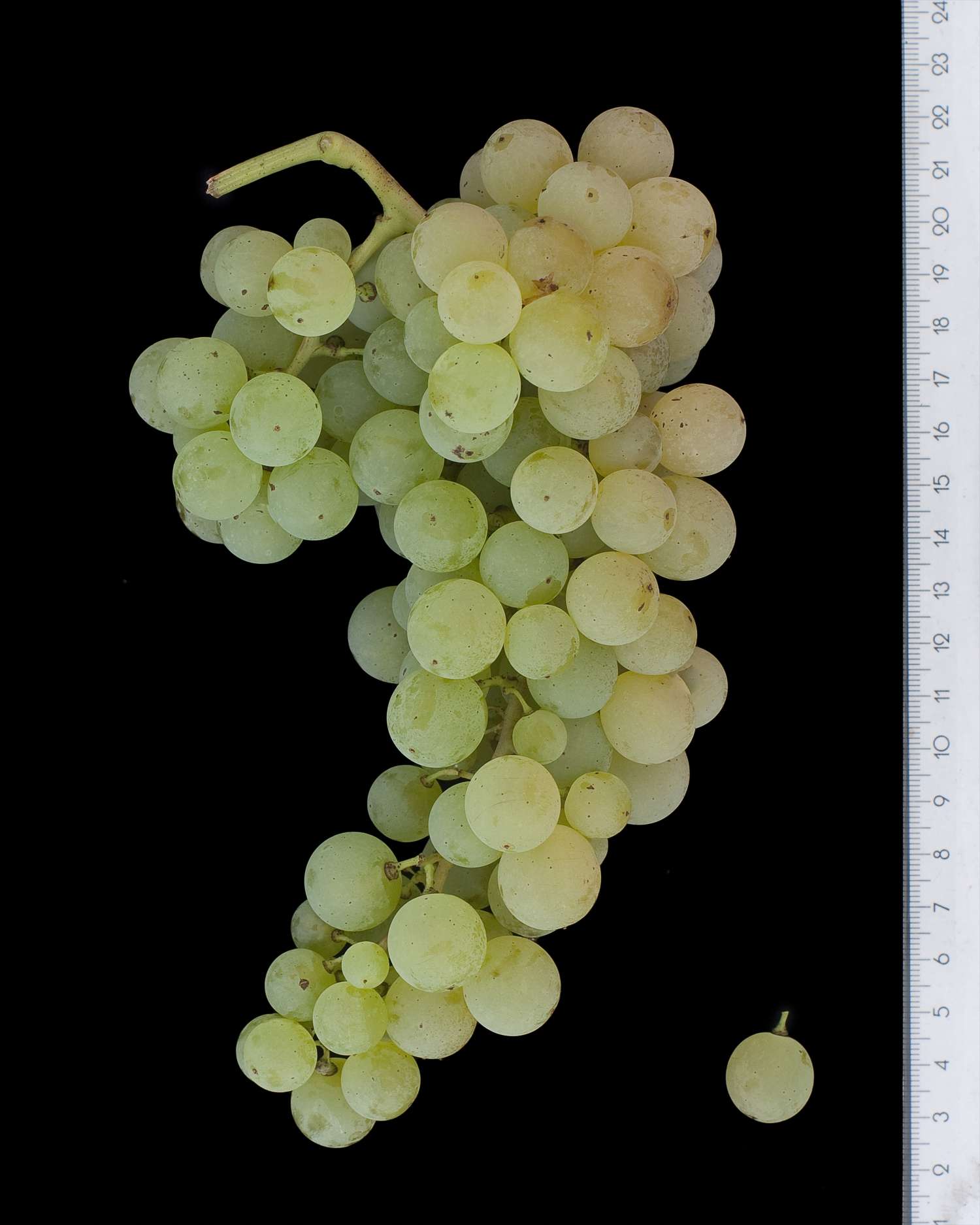
Malvasia Bianca di Candia is the most planted Malvasia in Italy, at roughly 8,600 hectares, and it is not the good one. It should not be confused with Malvasia di Candia Aromatica, a genuinely fine and genetically unrelated variety. This is the grape that, with Trebbiano Toscano, was written into law as the backbone of Frascati and did a great deal of damage to Lazio’s reputation.
Origins and history Venice, looking to increase the volume of a wine that sold extremely well, planted generic Malvasia vines on Crete and on many other islands, with a document recording Malvasia near Caiesa as early as 1363. Candia is the ancient Latin name for Crete, which is where the variety’s name comes from. What travelled under the Malvasia banner was never one grape, which is the root of every Malvasia confusion since.
Its place in the family A 2007 study showed that Malvasia Bianca di Candia is a genetically distinct variety, not an aromatic mutation of Malvasia di Candia Aromatica and unrelated to it. It is closely related to the red-berried Malvasia di Casorzo. More significantly, a landmark study of the same year established it as a progeny of Garganega, the grape of Soave, making it either a grandparent or half-sibling of Garganega’s other offspring: Albana, Catarratto Bianco, Dorona, Marzemina Bianca, Montonico Bianco, Mostosa, Susumaniello and Trebbiano Toscano.
The Malvasia Rossa puzzle The variety is sometimes called Malvasia Rossa, not for the colour of its berries or wine but because its apical buds are intensely red. Lazio growers have long insisted that a genuinely different Malvasia Rossa exists, reduced to a few old vines in largely abandoned vineyards. There is no genetic evidence for it, and D’Agata reports that some vines shown to him looked much like the Candia variety and others very different, leaving the question open.
In the vineyard The bunch is conical, and both bunch and berries are large, with thin skins, in direct contrast to the thick-skinned Malvasia di Candia Aromatica. Four biotypes have been described through ampelographic and molecular analysis, differing by berry and bunch size, with a clear correlation between molecular profile and bunch morphology. Seven clones became available between 1969 and 2009.
Why so much survives Plantings fell only 1.7 per cent between 2000 and 2010, which D’Agata finds surprising given the push for quality. The explanation is agronomic rather than qualitative: it is a dependable and generous yielder, vulnerable only to humid conditions, rainy springs and excessively wet soils, especially on vigorous rootstocks, where berry shatter reduces the crop. Reliability has kept it in the ground.
Appearance and structure The wines are neutral and non-aromatic, lacking both the perfume of the aromatic Malvasias and the creamy, resiny texture that distinguishes Malvasia del Lazio. Where yields are controlled and the better clones used, the result is a clean, unobjectionable white. At the volumes normally asked of it, it is dilute.
Aromatic profile The clone determines much of what little there is. The two University of Milan clones are complementary: VV200 gives wines with a strong herbal aroma and VV220 something with more of a tropical-fruit flair, a very relative flair in D’Agata’s judgement. Used together they produce a more interesting wine than either alone. The Ampelos TEA 20 and TEA 22 clones yield slightly less and are considered the quality options.
In the cellar Its main role is as a blending component across Lazio, Emilia-Romagna, Umbria, Tuscany, the Marche and Campania. The 2011 revision of the Frascati rules loosened its grip by permitting Malvasia del Lazio as an alternative, which is the single most useful thing that has happened to the wines of the Castelli Romani in decades.
Key expressions
- Frascati and Castelli Romani whites, where it has long dominated the blend.
- Low-yield bottlings using the Ampelos or paired UNIMI clones.
- Blends across Emilia-Romagna, Umbria and Tuscany.
- Varietal wines where a grower has deliberately restricted the crop.
The question of aging None to speak of. The wine is at its best within a year and has neither the acidity nor the extract to develop, turning flat and faintly bitter thereafter. This is a grape for immediate, uncomplicated drinking, and treating it otherwise is a category error.
At the table It works as a neutral partner to simple Roman food, fried artichokes, seafood pasta, mozzarella, where inoffensiveness is a genuine virtue. It will not compete with anything. Serve it cold, around eight degrees.
Why it matters Malvasia Bianca di Candia is the clearest case in Italy of a grape whose success rests on yield and reliability rather than quality, and of the damage that does when legislation makes it compulsory. It is also, through Garganega, closer to the centre of the Italian family tree than its reputation suggests. Understanding what it is not is the fastest way to understand every other Malvasia.